

 |
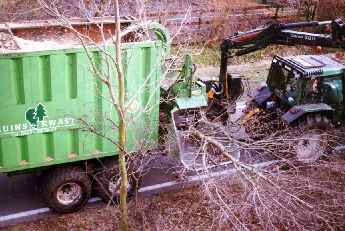
| A mobile chipper with crane efficiently collects roadside thinnings for fuel (Courtesy of Bruins and Kwast, Netherlands) |
The characteristics and quality of biomass as a fuel depend on the kind of biomass and the pre-treatment technologies applied. For example, the moisture content of the fuel as fed into the furnace may vary from 25 to 55 wt% for bark and sawmill by?products, and be less than 10 wt% for pellets. Also, the ash sintering temperatures of biofuels used cover a wide range (800 to 1200°C), as do particle shapes and sizes. Fuel quality can be improved by suitable pre-treatment technologies, but this increases costs.
Different combustion technologies are available to deal with various fuel qualities – less homogeneous and low-quality fuels need more sophisticated combustion systems. Therefore, and for “economy of scale” reasons, only medium and large-scale systems are suitable for low-quality and cheap biofuels. The smaller the combustion plant, the greater the need for fuel quality and homogeneity.
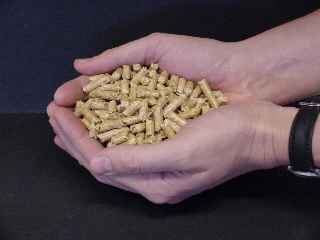 |
| Clean and dry woodpellets are an ideal fuel for combustion in small-scale installations |
The chemical fuel composition has a direct influence on combustion characteristics, ie energy content, ash deposition, emissions, corrosion mechanisms, as well as ash behaviour inside a boiler. It is therefore important to know probable variations in chemical fuel composition. Task 32 has prepared a database covering the chemical composition of fuel, ash, and condensate samples of fuels really used in installations, and this can be accessed through the internet.